There is a meaningful shift underway in ecommerce platforms. It goes beyond new features or incremental improvements.
We are moving from systems that require constant manual input to systems that can interpret data, make decisions, and take action in real time.
This shift is being driven by advancements in AI and unified data platforms, with partners like Klaviyo playing a role in how this capability is being delivered to merchants. It is influencing how Shopify ecosystems are designed, connected, and optimised.
Why This Matters for Shopify Merchants
For most ecommerce teams, growth is still heavily dependent on manual effort. Campaigns are built by hand, audiences are segmented manually, and optimisation relies on available time and internal resources.
As brands scale, this model becomes harder to sustain. Complexity increases, execution slows, and opportunities are missed because teams simply cannot keep up.
The shift toward more autonomous systems directly addresses this challenge.
When implemented well, it enables:
- More relevant customer experiences without increasing workload
- Faster execution across campaigns and channels
- Continuous optimisation based on real customer behaviour
- Better use of existing data to drive revenue
In practical terms, it allows teams to spend less time operating tools and more time focusing on strategy and growth.
Key takeaway:
This shift is about removing the operational ceiling that limits how far your team can scale.
What Is Autonomous Ecommerce and How Is It Changing Shopify Systems
Traditionally, ecommerce platforms have been designed as systems of record. Their primary role has been to collect and store customer data, leaving it up to internal teams to interpret that data, decide on next steps, and execute campaigns or experiences manually.
That model is starting to shift.
We are now seeing the emergence of systems that move beyond storing information and begin acting on it. Instead of waiting for a marketer to analyse behaviour and trigger a campaign, these systems can interpret customer signals in real time and respond accordingly.
This is what sits behind the idea of autonomous ecommerce.
In practical terms, this means:
- Customer behaviour is analysed in real time rather than after the fact
- Intent is predicted, such as the likelihood to purchase or disengage
- Messaging, timing, and channel selection adjust automatically per individual
- Campaigns and flows improve continuously based on performance data
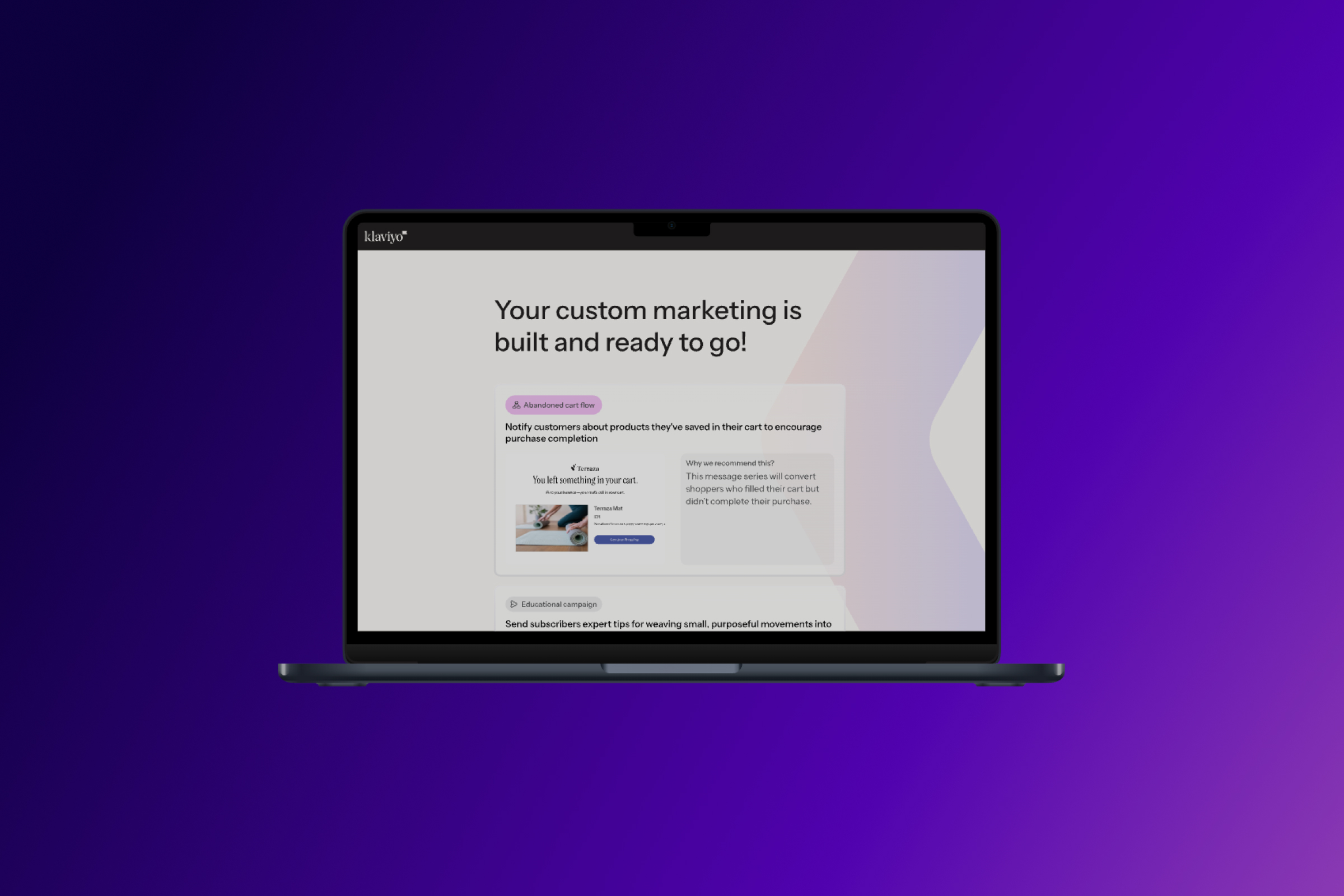
Klaviyo’s positioning around an autonomous B2C CRM is one example of how this is being delivered within the Shopify ecosystem, and the broader shift applies across the entire stack. It is the combination of a unified data layer, built-in intelligence, and connected execution across channels that enables this change.
For merchants, this represents a move away from heavily manual workflows toward a more adaptive system where decision-making and execution are increasingly supported by the platform itself.
Key takeaway:
Your ecommerce platform is evolving from a system that supports decisions to one that actively helps make them.
What This Looks Like in Practice for Enterprise Shopify Builds
Orchestrated customer journeys, not channel-led campaigns
Enterprise brands are moving away from isolated channel strategies and toward coordinated customer journeys. Email, SMS, onsite experiences, and emerging channels are planned together as part of a single lifecycle.
This shift is supported by tools that allow multi-channel orchestration, but the real impact comes from how journeys are designed. Messaging becomes more consistent, timing becomes more responsive, and channels are used based on customer behaviour rather than internal preference.
Key takeaway:
Growth comes from how channels work together, not how each performs individually.
Real-time audiences instead of static segments
Static segmentation has long been a limiting factor, particularly for brands with large and complex datasets.
With the introduction of predictive models and dynamic audience management, targeting can now evolve continuously. Customers can be included or excluded based on their likelihood to engage, convert, or churn.
This creates more relevant campaigns and reduces wasted sends.
Key takeaway:
Audience quality is no longer fixed. It should adapt as quickly as customer behaviour changes.
Continuous optimisation is built into the system
Optimisation has traditionally been a manual process. Teams review results, identify opportunities, and implement tests over time.
Autonomous systems shift this by embedding optimisation directly into execution. Send times, content variations, and channel selection can all be adjusted automatically based on performance signals.
At scale, this creates compounding gains without increasing workload.
Key takeaway:
Performance improvements should not rely on available time. They should be built into the system itself.
Personalisation as a core layer of the storefront
Product recommendations and personalised experiences are becoming more advanced and more widely applied.
They are no longer limited to email. They extend across onsite experiences, messaging channels, and post-purchase interactions.
For enterprise Shopify builds, this has implications across merchandising, UX, and data architecture. Personalisation needs to be considered as part of the core experience, not an add-on.
Key takeaway:
Personalisation is not a feature. It is a foundational layer of modern ecommerce.
Customer service as part of the revenue system
Customer service is increasingly connected to marketing and sales outcomes.
With AI-powered support and unified data, service interactions can:
- Resolve issues quickly
- Recommend relevant products
- Influence purchase decisions in real time
This reduces support load while also creating new revenue opportunities.
Key takeaway:
Service is no longer a separate function. It is part of the customer journey and should be designed accordingly.
A more adaptive storefront experience
The storefront itself is evolving into a more dynamic environment.
With better data integration and real-time capabilities, onsite experiences can adapt based on individual behaviour. Content, offers, and product recommendations can change to reflect each customer’s context.
For Shopify Plus merchants, this requires a flexible approach to frontend architecture and a strong connection between systems.
Key takeaway:
Your storefront should respond to customers, not present the same experience to everyone.
Where to Start Adopting This Approach
For most brands, adopting this shift does not require a complete rebuild. It starts with improving how existing systems are connected and used.
A practical approach:
- Strengthen your data foundation
Ensure Shopify, CRM, and key platforms are properly integrated and sharing accurate, real-time data. - Move beyond static segmentation
Introduce dynamic and behaviour-based audiences to improve targeting and relevance. - Enable built-in intelligence features
Leverage capabilities such as personalised send times, predictive insights, and automated recommendations. - Connect your channels
Align email, SMS, onsite, and support experiences so they work together as part of a unified journey. - Introduce automation gradually
Start with optimisation and build toward more advanced system-led execution over time.
Key takeaway:
Progress comes from improving how your current systems work together, not from adding more tools.
Working Towards a More Connected Shopify System
Most enterprise teams are not lacking capability. They are working with systems that are not fully aligned.
The opportunity is to design an ecosystem where data, marketing, service, and onsite experience work together as a cohesive system.
That is where the real gains are made.
As a Klaviyo partner, Process Creative works closely with brands to ensure their CRM and broader Shopify ecosystem are structured to support this shift. That includes everything from data architecture and platform integration through to how customer journeys are designed and optimised over time.
If you are exploring how to evolve your Shopify platform in this direction, we can support both the system design and the practical implementation needed to make it work at scale.
Further Reading
Many of the shifts outlined in this article are reflected in Klaviyo’s latest product direction and their perspective on autonomous marketing and customer service.
You can explore their full update here:
https://www.klaviyo.com/blog/klaviyo-ai-for-autonomous-marketing-and-customer-service
It provides additional context on how these capabilities are being developed at a platform level, and where the ecosystem is heading next.