Google and Shopify just gave us one of the clearest signals yet about where ecommerce is heading.
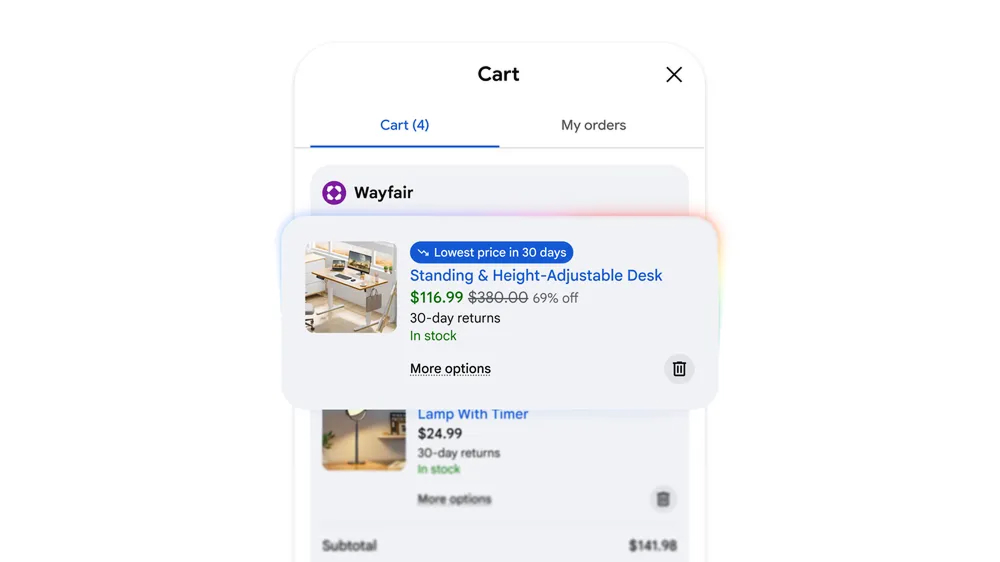
At Google I/O 2026, Google introduced Universal Cart — an AI-powered shopping cart that follows customers across Search, Gemini, YouTube and Gmail.
At almost the same time, Shopify opened its Universal Commerce Protocol and Shopify Catalogue access to all developers.
On the surface, these look like separate announcements.
In reality, they point to the same shift:
Commerce is no longer confined to individual websites or marketplaces. It’s becoming embedded across the internet itself.

What Google actually announced
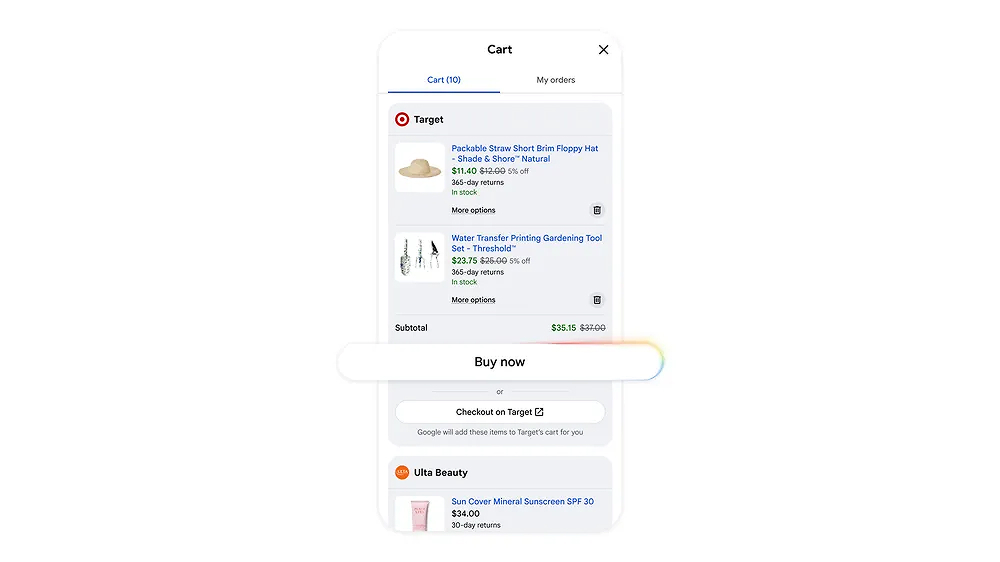
Google’s Universal Cart allows customers to add products from multiple retailers into a single cart while browsing across Google’s ecosystem.
A shopper might:
- Discover a product through Search
- Watch a review on YouTube
- Ask Gemini for recommendations
- Open a promotional email in Gmail
- Continue building the same cart across all of those experiences
But the real shift isn’t the cart, it’s the intelligence layer sitting behind it.
Google’s AI actively monitors pricing, surfaces deals, tracks restocks, flags incompatible products and even recommends payment methods that maximise rewards or loyalty benefits.
This moves shopping from passive browsing to assisted decision-making.
Importantly, Google is not becoming the merchant of record. Brands still own the transaction, fulfilment and customer relationship. Google is positioning itself as the infrastructure layer connecting discovery to checkout.
That distinction is what makes this significantly more viable than earlier AI commerce experiments.
Rather than asking consumers to adopt entirely new behaviour, Google is embedding commerce into platforms people already use every day.
Shopify’s move may be even bigger
At the same time, Shopify announced that its Universal Commerce Protocol is now open to all developers.
Previously, only selected partners like ChatGPT, Gemini and Perplexity had access to Shopify’s commerce infrastructure and catalogue data.
Now, any developer can build on top of it.
That means AI tools, apps, content platforms and recommendation engines can potentially access millions of Shopify merchants and billions of products through a single commerce layer.
For years, people expected Shopify to build a marketplace to compete with Amazon.
Instead, Shopify appears to be doing something much more strategic.
It’s turning the internet itself into the marketplace.
Every new commerce surface built on top of Shopify’s infrastructure becomes another discovery channel for merchants, without requiring brands to build custom integrations for each platform individually.
What this changes for Shopify merchants
Historically, ecommerce strategy has focused heavily on driving traffic to owned websites.
But these announcements suggest discovery and conversion are increasingly moving beyond traditional storefronts.
Products may soon be surfaced through:
- AI assistants
- recommendation engines
- creator content
- search interfaces
- embedded shopping experiences
- messaging platforms
- voice interactions
Your website still matters.
But it may no longer be the primary place customers first encounter your products.
That changes the role of ecommerce infrastructure.
The brands best positioned for this shift won’t simply have the best-looking storefronts. They’ll have the most accessible, machine-readable and interoperable commerce systems.
What merchants should focus on right now
Most brands do not need to overhaul their ecommerce stack overnight.
But there are a few areas that are becoming increasingly important.
1. Product data quality
AI systems rely on structured product information to surface and recommend products effectively.
That means:
- clean product titles
- accurate specifications
- strong descriptions
- structured metadata
- inventory accuracy
- consistent categorisation
Your product catalogue is quickly becoming a strategic asset, not just operational data.
2. Google Merchant Centre optimisation
Many merchants still treat Merchant Centre as a secondary feed for Shopping ads.
That mindset is likely to change.
If Google becomes a core commerce infrastructure layer, Merchant Centre data quality becomes significantly more important to visibility and discoverability.
3. Commerce interoperability
Brands need to think beyond webpages and storefront design.
Can external systems understand your products easily? Can platforms interact cleanly with your commerce stack? Is your product data structured properly for AI-driven discovery?
Increasingly, commerce experiences will happen across multiple surfaces — not just your website.
4. Brand still matters enormously
As discovery becomes more decentralised, brand becomes one of the few constants customers carry between platforms, recommendations and AI-driven experiences.
The brands that stand out won’t just be technically accessible.
They’ll be recognisable, trusted and memorable.
Because, regardless of how commerce evolves, customers still buy from brands they connect with.
What merchants should take from this
The important thing for Shopify merchants is that this shift is not happening outside the ecosystem they already operate in.
In many ways, Shopify brands are already well-positioned for where commerce is heading next.
The infrastructure being built by Google, Shopify and emerging AI platforms is designed to reward brands with strong product data, clear positioning and well-structured commerce experiences, not just the biggest advertising budgets.
That creates a real opportunity for ambitious merchants willing to adapt early.
The brands that invest now in their product ecosystem, customer experience and brand foundations are likely to become significantly more discoverable as these new commerce surfaces mature.
And while the technology is changing quickly, the core fundamentals remain remarkably consistent:
- Build a strong product
- Create a brand that customers remember
- Make the buying experience frictionless
- Ensure your commerce infrastructure is ready to scale
The channels may evolve.
The expectations around discoverability may shift.
But the brands that continue investing in clarity, trust and customer experience are still the ones most likely to win long term.
The next phase of ecommerce is already starting
Commerce is no longer confined to storefronts or marketplaces.
It’s becoming embedded into search, content, AI systems and the broader internet experience itself.
For merchants, the challenge now is not simply reacting to new technology; it’s understanding how to build a brand and commerce ecosystem that can adapt as customer behaviour evolves.
At Process Creative, we work with ecommerce brands to build Shopify experiences designed for long-term growth - balancing performance, infrastructure, conversion and brand strategy in a rapidly changing commerce landscape.
If you’re thinking about what the next phase of ecommerce means for your brand, get in touch with the Process team.